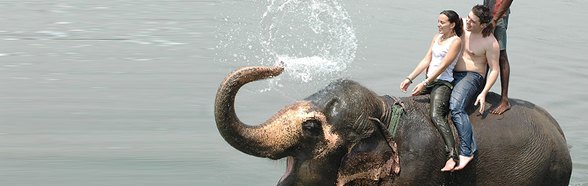
Nepal's first national park protects nearly 950 square kilometres of forest, marshes and tall grassland in the lowland Terai. It is on the UNESCO World Heritage List.
Chitwan is home to most of Nepal's greater one-horned rhinoceroses and to one of Asia's best-protected populations of Bengal tigers, as well as leopards, sloth bears, gaur, wild elephants, gharial and mugger crocodiles, and more than 500 species of birds. Some animals are easy to see; others are a rare privilege.
Around the park, the countryside is a mosaic of rice fields, mango orchards, bamboo groves and villages of the Tharu people, whose traditional houses are built of straw and dried mud.
What we can do there
Jeep safari
Tracks through the forest and grassland are the best way to cover ground and give the best chances of seeing rhinos, deer and, with luck, a tiger.
Guided jungle walk
With a specialist naturalist guide, we walk safely into the forest to read tracks and listen to the jungle. An unforgettable experience.
Birdwatching
With an ornithologist who knows every call, we look for the most discreet birds of the park. We translate, as local guides don't always speak your language.
Canoe on the Rapti
A dugout canoe glides slowly down the river past water birds and crocodiles; with a lot of luck, a river dolphin. The canoe drops us near the elephant breeding centre, which we can visit.
Tharu cultural evening
Village groups perform traditional Tharu songs and dances, including the stick dance, where a large circle of dancers strike their sticks together, and a humorous peacock dance. The income goes to the villagers.